AquaWeave: Weaving Liquid-Activated Morphing Bio-Textiles
In Human–Computer Interaction (HCI), weaving has been used to fabricate soft, interactive interfaces through complex structures and functional wefts. Recent work introduces biomaterials with dynamic behaviors into weaving. AquaWeave systematically investigates and compares how weave parameters mediate liquid-activated morphing behaviors across multiple bioyarn systems. We contribute fabrication and characterization of morphing bioyarns-- alginate, chitosan, gelatin--that enable swelling and dissolving properties, and a design menu of weaving structures to investigate how float length, weft density, yarn placement, and compound structures mediate and control these transformations. Through a workshop study, we capture textile practitioners’ perspectives on designing with morphing bio-textiles, highlighting the role of sampling in conveying material behavior and the importance of tactile engagement in shaping design decisions. Our findings show how weaving can shift material transformation from a failure mode to programmable deformation, while designing with morphing bio-textiles relies on embodied interaction with materials, where making, activation, and evaluation are closely intertwined.
Publication:
AquaWeave: Weaving Liquid-Activated Morphing Bio-Textiles
Jingwen Zhu, Eddie Zhu, Emily Fan, Megan Wu, Samantha Chang, Cindy Hsin-Liu Kao
Proceedings of the UIST 2026
PDF | DOI | Project Page
Project Credits:
Hybrid Body Lab at Cornell University, directed by Cindy Hsin-Liu Kao
Research Team: Jingwen Zhu (Lead Researcher), Eddie Zhu, Emily Fan, Megan Wu, Samantha Chang, Cindy Hsin-Liu Kao (Lab Director)
Press Inquiries: Press Image Kit: Download Here (License: CC by-NC-SA 4.0) Press Contact: Prof. Dr. Cindy Hsin-Liu Kao, cindykao@cornell.edu
This project was supported by the National Science Foundation (Grant IIS-2047249), the Cornell Atkinson Center for Sustainability Academic Venture Fund, and the Cornell College of Human Ecology Faculty Sustainability Research Grant.
AquaWeave
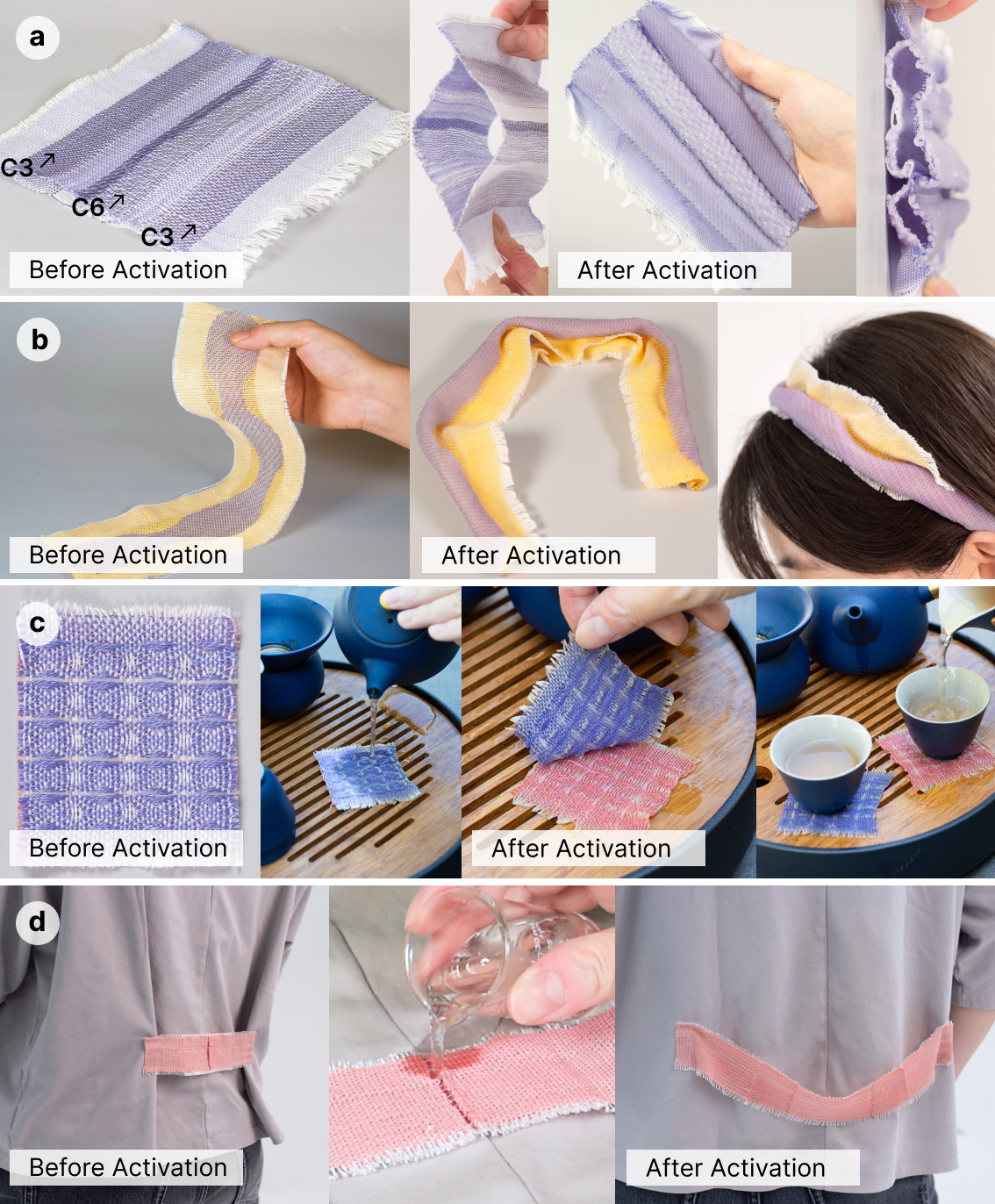
We present AquaWeave, weaving liquid-activated morphing bio-textiles. Example scenarios of swelling bioyarn: (a) Kitchen Towel to Sponge; (b) Hairband Styled from Hair Drying. Example scenarios of dissolving bioyarn: (c) Tea Cup Coaster for Sharing; (d) Expandable Adjustment Patch.

AquaWeave Theory of Operation
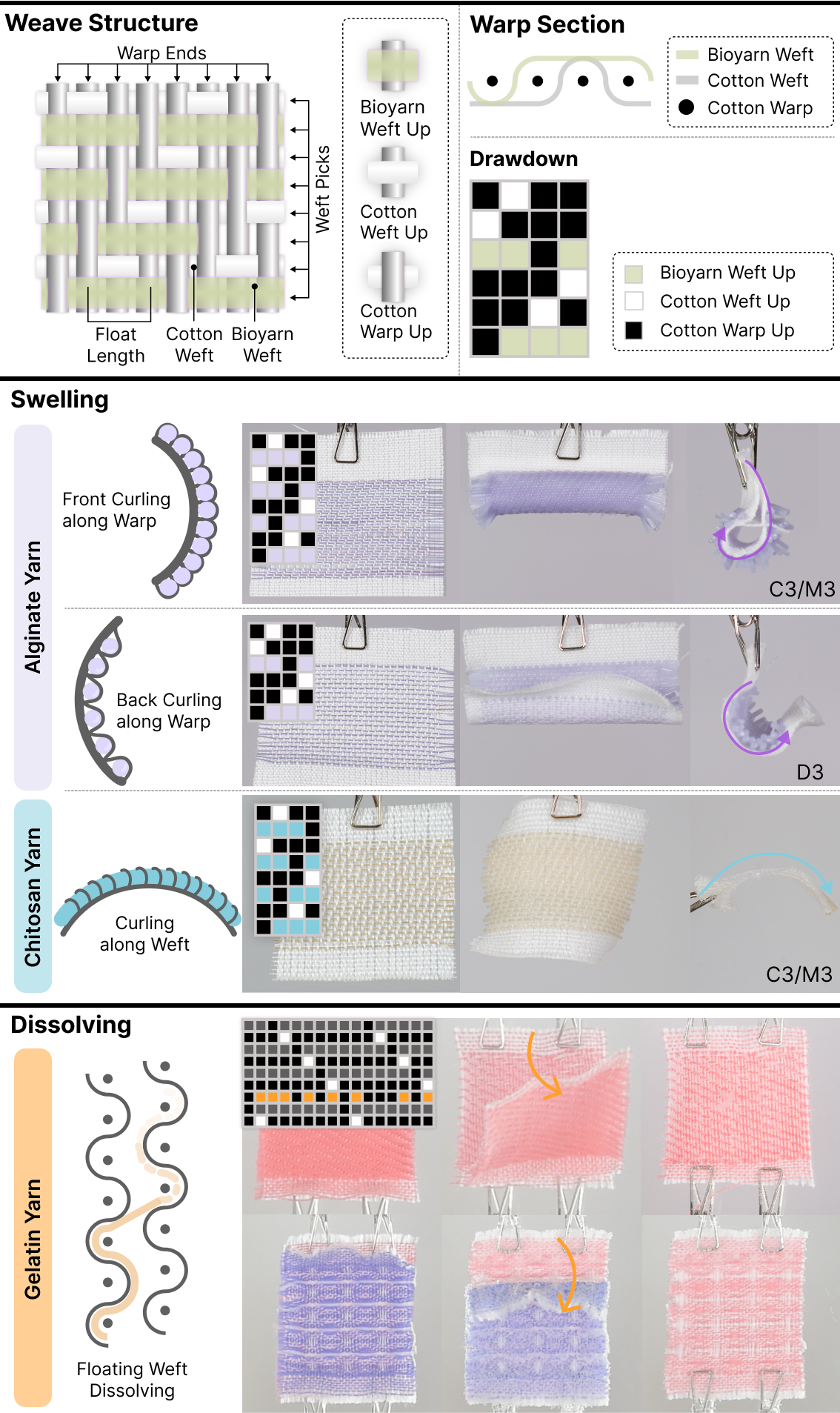
In AquaWeave, we explore three types of bioyarns--alginate, chitosan, and gelatin--with their corresponding liquid activation to achieve morphing. The alginate yarn swells when it absorbs water, the chitosan yarn swells in low pH conditions, and the gelatin yarn dissolves in warm water. We explored a series of weave structures that emphasize leveraging yarn properties to achieve maximum morphing when activated. We illustrate the theory of operation with examples of each morphing type.
AquaWeave Design Menu
Here, we present an overview of the AquaWeave design menu based on our synthesized design workflow for creating liquid-activated morphing textiles.
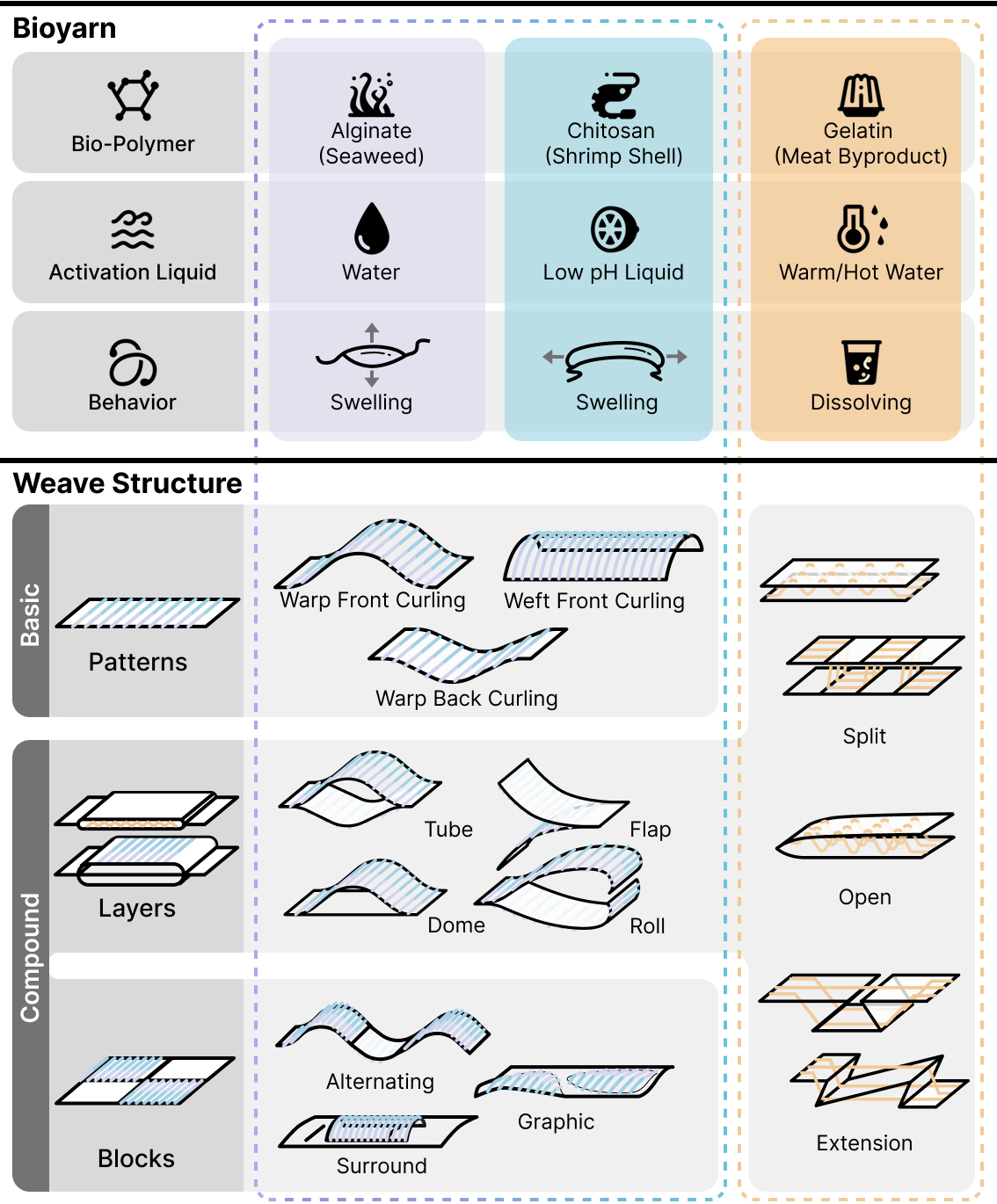
Bioyarns. Based on a review of morphing biomaterials, we selected three biopolymers suitable for fiber-based fabrication. Selection criteria included bio-based and biodegradable composition, compatibility with wet spinning using water-based solvents, non-toxic processing, and safety for home or studio use.
All bioyarns are monofilament fibers produced via wet spinning setups commonly used in HCI labs. We identified three recipes with distinct activation behaviors: alginate, which swells in room-temperature water (20--24C); gelatin, which dissolves in warm or hot water (40--80C); and chitosan, which swells under acidic conditions (pH < 4).
Weave Structures. In this work, we focus on weave structures compatible with both floor looms and digital jacquard looms, which are commonly used in HCI labs and textile education. In these settings, warp materials rarely change because loom dressing is time- and material-intensive. We therefore fix the warp as 16/2 mercerized cotton and use bioyarns exclusively as weft. Unlike approaches that incorporate functional yarns as warp, this strategy requires no loom setup changes and supports broader adoption across loom types. Our exploration combines single-layer and multi-layer structures, including their block-based compositions, to enable morphing behaviors. For each mechanism, swelling and dissolving, we identify compatible weave structures that support these transformations.
Basic Pattern. The basic pattern is the primitive that enables curling effects. In the pattern, swelling bioyarn wefts and cotton structural wefts are woven on opposite sides of the fabric to enable warp front curling, warp back curling, and weft front curling.
Compound -- Layer Arrangement. Layer arrangement creates a multi-layered structure that allows the stacking of single-layered basic patterns in opposite directions to form tubular, dome, roll, or flaps. For dissolving yarn specifically, we employ floating bioyarn between layers to achieve split, open, and extension structures.
Compound -- Block Arrangement. Block arrangement offers a wide range of combinations, from geometric to graphic shapes. Each block's pattern also interacts with its neighbors. For example, alternating blocks with opposite curling directions or surrounding curling patterns with constraining structures can create different effects.
Proof-of-Concept Scenarios
Kitchen Towel to Sponge (a). eW designed a woven towel that transforms into a textured scrubber when soaked in water. In its dry state, it functions as a standard kitchen towel. By alternating warp-front curling structures, C3 and C6, with Tube as the compound combination, the alginate bioyarn produces regions of different stiffness for cleaning. The swelling is reversible, allowing the textile to return toward its flat form after drying.
Hairband Styled from Hair Drying (b). We leverage water from showering and hair drying as the activation source. A flat woven hairband morphs into a segmented 3D form as it absorbs water. Alginate bioyarns of pattern C3 arranged in Graphic block patterns induce localized curling. The final form varies with moisture, ambient humidity, and material absorption, and is reversible across drying cycles.
Tea Cup Coaster for Sharing (c). We designed a double-layer coaster using the Split structure that leverages hot tea as the activation liquid. In its pre-activation state, it functions as a single coaster. When exposed to hot water, interwoven gelatin yarns dissolve, separating the structure into two coasters. This transformation is intentionally non-reversible. The material change supports the transition that aligns with the ritual of tea preparation, where heat and liquid are already present.
Expandable Adjustment Patch for Clothing (d). We designed an expandable patch using gelatin bioyarns in the Extension weave structure. When applied to loose garments, the patch tightens the fit. When exposed to hot water during wash cycles, the dissolution of gelatin bioyarns expands the structure and restores the original fit.
Workshop Study with Textile Practitioners
We conducted a remote workshop with five textile practitioners. Participants were provided with materials and worked in their own studios using their existing looms and workflows. This study focuses on alginate bioyarn and its swelling-based design parameters.
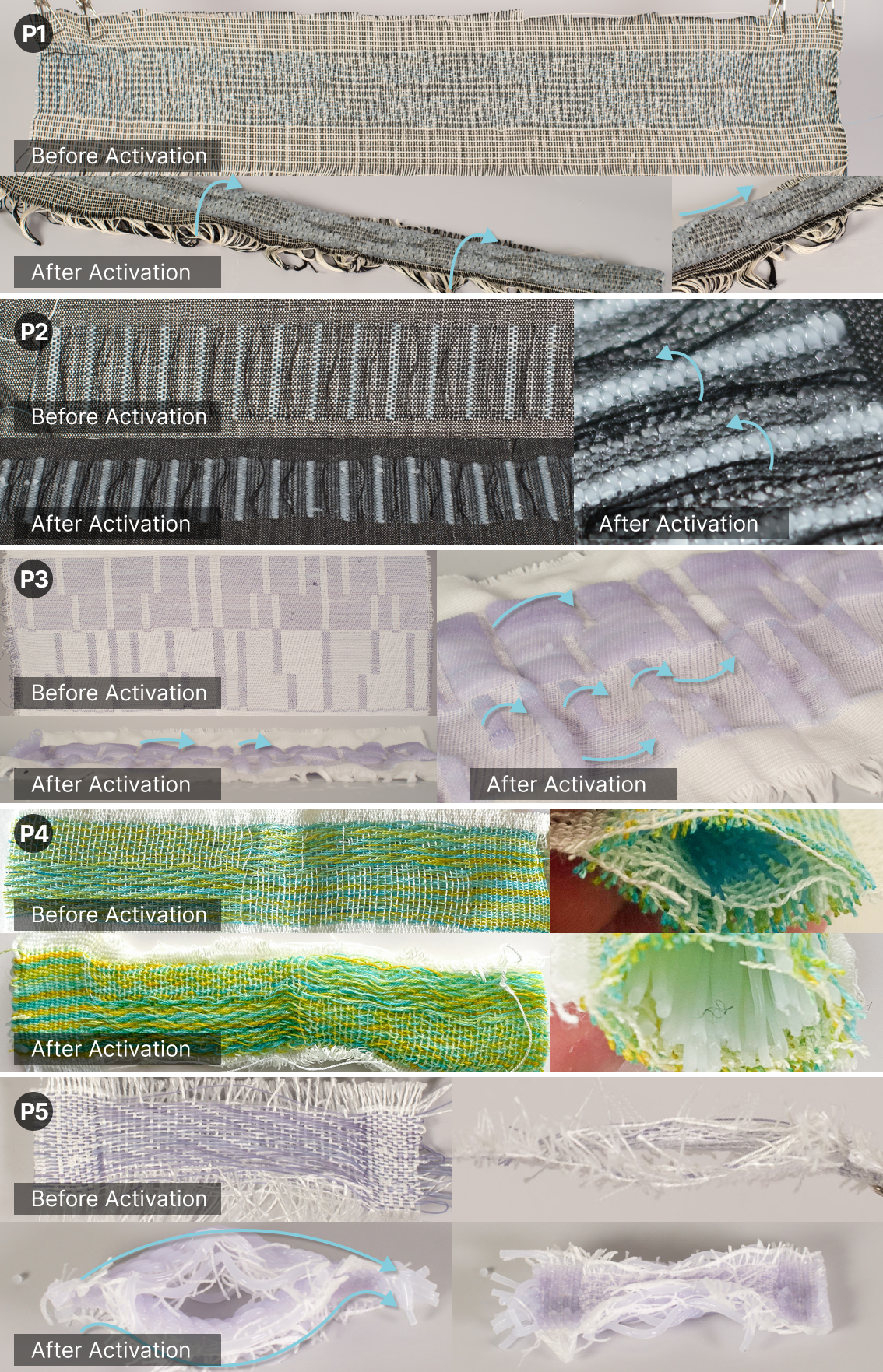
P1's Design: Exploration of Shaped Patterns. P1, a textile artist with 20 years of experience and familiarity with non-traditional materials such as metal wires and fiber optics, explored warp-front curling using diamond patterns. She first iterated on diamond geometry using cotton-only wefts, scaling the pattern to achieve the desired form. To test the structure while conserving materials, she wove the design using two cotton wefts, substituting one for bioyarn, before replacing it with alginate bioyarn in the final sample.
The resulting pattern alternates long and short bioyarn float lengths. Upon water activation, long floats protrude while shorter floats constrain deformation, producing localized warp-front curling and a textured surface.
P2's Design: Ribbed Textures. P2, a textile artist whose practice focuses on high-resolution woven imagery through high weft density, explored reducing warp density through floating warps to create space for bioyarn swelling. She designed a pattern with alternating float lengths to induce pleating after activation. However, the balanced interlacing of bioyarn and cotton wefts across short spans limited differential expansion, preventing pronounced pleating. Despite this, the reduced warp density enabled localized bioyarn swelling, resulting in a subtle ribbed texture.
P3's Design: Scripted Alternating Blocks. P3 is an arts administrator and researcher with intermediate weaving experience gained through managing a textile studio. He developed a computational approach to pattern generation by scripting float length variations in Python. He generated gradients of float lengths across the fabric width and mirrored the pattern to control curling direction. After weaving with alginate bioyarn, activation produced directional curling in distinct regions, corresponding to the programmed float-length distribution.
P4's Design: Triple-Layer Structure Revealing. P4 is an artist whose practice focuses on exploring textile structures and surface textures. He explored multi-layer weaving by constructing a triple-layer textile with loose satin weaves in each layer and embedding bioyarn in the middle layer. The structure was designed to provide sufficient internal space for bioyarn expansion. Upon activation, swelling revealed the previously hidden bioyarn layer, making internal structures visible through deformation.
P5's Design: Double Weave with Varied Curling.P5 is a design student with two years of weaving experience. She designed a double weave structure combining two twill patterns with different float lengths to induce differential curling. Instead of placing the bioyarn on the outer surface, she positioned it on the inner side of the bottom layer. After activation, this configuration produced a double-layer textile with distinct curling behaviors across layers.
Acknowledgments:
We thank all the participants for their active involvement and insightful feedback. We thank Julia Wright for her advice on weave drafting and Yingjie Bei for photography support. This project is funded by the National Science Foundation under Award IIS-2047249, the Cornell Atkinson Center for Sustainability Academic Venture Fund, and the Cornell College of Human Ecology Faculty Sustainability Research Grant.